
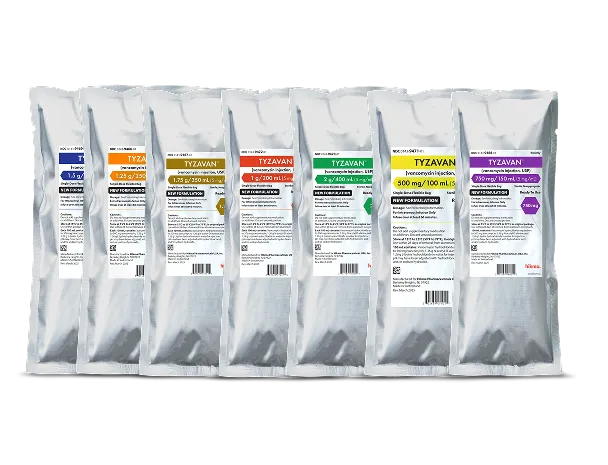


On-Demand Convenience

No preparation required1
Just remove from overpouch and administer

ADC-compatible
Fits in most automatic dispensing cabinets

Fits most tubing and pumps
Works with most tubing and pump brands, including universal tubing and pumps
TYZAVAN™ Products1*
Swipe to the left to see full table
| Total unit content | Label color | Unit of sale NDC | Total premix bag volume | Pack size (bags per case) | Bag barcode | Carton barcode |
|---|---|---|---|---|---|---|
| 500 mg |  | 0143-9471-12 | 100 mL | 12 |  |  |
| 750 mg |  | 0143-9468-12 | 150 mL | 12 |  |  |
| 1 g |  | 0143-9472-12 | 200 mL | 12 |  |  |
| 1.25 g |  | 0143-9466-06 | 250 mL | 6 |  |  |
| 1.5 g |  | 0143-9469-06 | 300 mL | 6 |  |  |
| 1.75 g |  | 0143-9467-06 | 350 mL | 6 |  |  |
| 2 g |  | 0143-9470-06 | 400 mL | 6 |  |  |
*TYZAVAN™ concentration for all strengths is 5 mg/mL1
Billing and Reimbursement
Use the J-code below to submit claims for TYZAVAN™
| J-Code: | J3375 |
|---|---|
| Description: | Injection, vancomycin hydrochloride, not therapeutically equivalent to J3373, 10 mg. |
| Effective Date: | November 14, 2025 |
Order TYZAVAN™
TYZAVAN™ can be purchased through several major distributors, including Cencora, Cardinal, McKesson, and Morris & Dickson, or by contacting your Sales Representative.
Support
Enter your information below to be contacted by a member of our team.
Important Safety Information for TYZAVAN™ (vancomycin injection, USP):
CONTRAINDICATIONS
TYZAVAN™ is contraindicated in patients with known hypersensitivity to vancomycin.
WARNINGS & PRECAUTIONS
- Infusion Reactions – Hypotension, including shock and cardiac arrest, wheezing, dyspnea, urticaria or pruritus, muscular and chest pain and “vancomycin infusion reactions” which manifests as pruritus and erythema face, neck and upper body pruritus and erythema may occur with rapid TYZAVAN™ administration (e.g., over several minutes). The reactions may be more severe in pediatric patients. To reduce the risk of infusion reactions, administer TYZAVAN™ over a period of 60 minutes or greater and also prior to intravenous anesthetic agents.
- Nephrotoxicity – TYZAVAN™ can result in acute kidney injury (AKI), including acute renal failure, mainly due to interstitial nephritis or less commonly acute tubular necrosis. Monitor renal function in all patients.
- Ototoxicity – Ototoxicity may be reversible or permanent in patients receiving vancomycin. It is higher risk in older patients and patients who are receiving higher doses and manifests as tinnitus, hearing loss, dizziness or vertigo. Serial tests of auditory function may be helpful.
- Severe Dermatologic Reactions – such as toxic epidermal necrolysis (TEN), Stevens-Johnson syndrome (SJS), drug reaction with eosinophilia and systemic symptoms (DRESS), acute generalized exanthematous pustulosis (AGEP), and linear IgA bullous dermatosis (LABD) have been reported in association with the use of vancomycin. Cutaneous signs or symptoms reported include skin rashes, mucosal lesions, and blisters. Discontinue TYZAVAN™ at the first appearance of any signs and symptoms of TEN, SJS, DRESS, AGEP, or LABD.
- Clostridioides difficile-Associated Diarrhea (CDAD) – has been reported with use of nearly all antibacterial agents, including vancomycin and may range in severity from mild diarrhea to fatal colitis. Evaluate patients if diarrhea occurs.
- Hemorrhagic Occlusive Retinal Vasculitis (HORV) – including permanent loss of vision, occurred in patients receiving intracameral or intravitreal administration of vancomycin during or after cataract surgery. The safety and efficacy of vancomycin administered by these routes have not been established by adequate and well-controlled trials. Vancomycin is not indicated for the prophylaxis of endophthalmitis.
- Neutropenia – Reversible neutropenia has been reported in patients receiving vancomycin. Periodically monitor leukocyte count.
- Phlebitis and Other Administration Site Reactions – Inflammation at the injection site has been reported. Vancomycin is irritating to tissue and must be given by a secure intravenous route of administration to reduce the risk of local irritation and phlebitis. Thrombophlebitis may occur. Administration of TYZAVAN™ by intramuscular (IM), intraperitoneal, intrathecal (intralumbar or intraventricular), or intravitreal routes has not been approved and is not recommended. The safety and efficacy of vancomycin administered by these routes have not been established by adequate and well controlled trials.
- Development of Drug-Resistant Bacteria – Prescribing TYZAVAN™ in the absence of a proven or strongly suspected bacterial infection or a prophylactic indication is unlikely to provide benefit to the patient and increases the risk of the development of drug-resistant bacteria.
ADVERSE REACTIONS
The most common adverse reactions are: (i) anaphylaxis; (ii) “vancomycin infusion reactions”; (iii) acute kidney injury; (iv) hearing loss; and (v) neutropenia.
DRUG INTERACTIONS
- Anesthetic Agents: Concomitant administration of vancomycin and anesthetic agents has been associated with erythema and histamine-like flushing.
- Piperacillin-Tazobactam: Studies have detected an increased incidence of acute kidney injury in patients administered concomitant piperacillin/tazobactam and vancomycin as compared to vancomycin alone. Monitor kidney functions.
- Ototoxic and/or Nephrotoxic Drugs: Concurrent and/or sequential systemic or topical use of other potentially neurotoxic and/or nephrotoxic drugs requires more frequent monitoring of renal function.
USE IN SPECIFIC POPULATIONS
- Pregnancy: The available data on the use of this formulation of TYZAVAN™ (which includes the excipient NADA) in pregnant women are insufficient to evaluate for a drug-associated risk of major birth defects, miscarriage, or other adverse maternal or fetal outcomes.
- Lactation: There are insufficient data to inform the levels of vancomycin in human milk. There are no data on the effects of vancomycin on the breastfed infant or milk production.
- Pediatric Use: More severe infusion related reactions related to vancomycin administration may occur in pediatric patients. In pediatric patients, monitor vancomycin serum concentration and renal function when administering TYZAVAN™.
- Geriatric Use: TYZAVAN™ is known to be substantially excreted by the kidney, and the risk of adverse reactions to this drug may be greater in patients with impaired renal function. Because elderly patients are more likely to have decreased renal function, care should be taken in dose selection, and it may be useful to monitor renal function.
- Renal Impairment: Dosage adjustment of Vancomycin Injection must be made in patients with impaired renal function. Measure trough vancomycin serum concentrations to guide intravenous therapy, especially in patients with impaired renal function or fluctuating renal function.
OVERDOSAGE
Supportive care is advised, with maintenance of glomerular filtration. Vancomycin is poorly removed by dialysis. Hemofiltration and hemoperfusion with polysulfone resin have been reported to result in increased vancomycin clearance. For current information on the management of overdosage, contact the National Poison Control Center at 1-800-222-1222 or www.poison.org.
INDICATIONS AND USAGE
TYZAVAN™ is a glycopeptide antibacterial indicated in adults and pediatric patients (1 month and older) for whom appropriate dosing with this formulation can be achieved for the treatment of the following infections:
- Septicemia
- Infective Endocarditis
- Skin and Skin Structure Infections
- Bone Infections
- Lower Respiratory Tract Infections
To reduce the development of drug-resistant bacteria and maintain the effectiveness of TYZAVAN™ and other antibacterial drugs, TYZAVAN™ should be used only to treat or prevent infections that are proven or strongly suspected to be caused by susceptible bacteria. When culture and susceptibility information are available, they should be considered in selecting or modifying antibacterial therapy. In the absence of such data, local epidemiology and susceptibility patterns may contribute to the empiric selection of therapy.
For more information about TYZAVAN™, please see the Full Prescribing Information or contact Hikma Pharmaceuticals USA Inc. at [email protected] or 1-877-845-0689.
You are encouraged to report negative side effects of prescription drugs to the FDA. To report SUSPECTED ADVERSE REACTIONS, contact Hikma Pharmaceuticals USA Inc. at 1-877-845-0689 or the FDA at 1-800-FDA-1088 or www.fda.gov/medwatch.
Manufactured for:
Hikma Pharmaceuticals USA Inc.
Berkeley Heights, NJ 07922 USA
Made in Switzerland
References: 1. TYZAVAN™ Prescribing Information. Hikma Pharmaceuticals USA Inc.; 2025. 2. Hikma Pharmaceuticals. Hikma receives FDA approval for TYZAVAN™ (vancomycin injection, USP) in the US. www.hikma.com/news/hikma-receives-fda-approval-for-tyzavan-vancomycin-injection-usp-in-the-us/. Accessed December 4, 2025.
Important Safety Information for TYZAVAN™ (vancomycin injection, USP):
CONTRAINDICATIONS
TYZAVAN™ is contraindicated in patients with known hypersensitivity to vancomycin.